

Author: Kaspars Kauliņš, Head of International Business Development at Tilde
The European Accessibility Act comes into force on 28 June 2025, and it will change how businesses across Europe make their products, services and information accessible to people with disabilities.
According to the Council of Europe data on 2022, 27% of the European population over 16 years of age have functional limitations. The figures are even worse in Latvia, where the situation is the worst in Europe, with 38.5% of the population suffering from functional limitations. What it means in their daily lives is that these people, for example, are unable to use information in the way healthy people can. Europe has a plan to address this problem through the Accessibility Act, as noted Kaspars Kauliņš, “Tilde” Business Development Director.
The preparation period for the application of the European Union (EU) directive on the accessibility requirements for products and services ends on 28 June 2025. Europe is not unique in this sense though, as similar documents have also been introduced in Australia, the United Kingdom, Canada, the USA and Japan. The EU Directive provides that service providers and manufacturers must ensure the accessibility of their information so that it can be both perceived and used by persons with disabilities.
This means that the internet environment as well as that of various on-site events will become more accessible. This is a tool by which the EU reinforces accessibility as one of its basic values.
It also increases responsibility and highlights various accessibility aspects, imposing an obligation to ensure compliance. Hopefully, this is not just a formal expression of care. Hopefully, we will really think about it.
What is the European Accessibility Act?
European Accessibility Act (Directive EU 2019/882) is an EU law that sets common accessibility requirements for key products and services across the European Union. It became enforceable on 28 June 2025 and covers digital and physical essentials such as e-commerce, online banking, websites, mobile apps, e-books, ticketing machines and smartphones. The goal is to remove barriers so that people with disabilities can access information and services on equal terms.
For businesses, the European Accessibility Act means that products and services placed on the EU market must meet defined accessibility standards. This affects both service providers and manufacturers, from public institutions to private companies operating online.
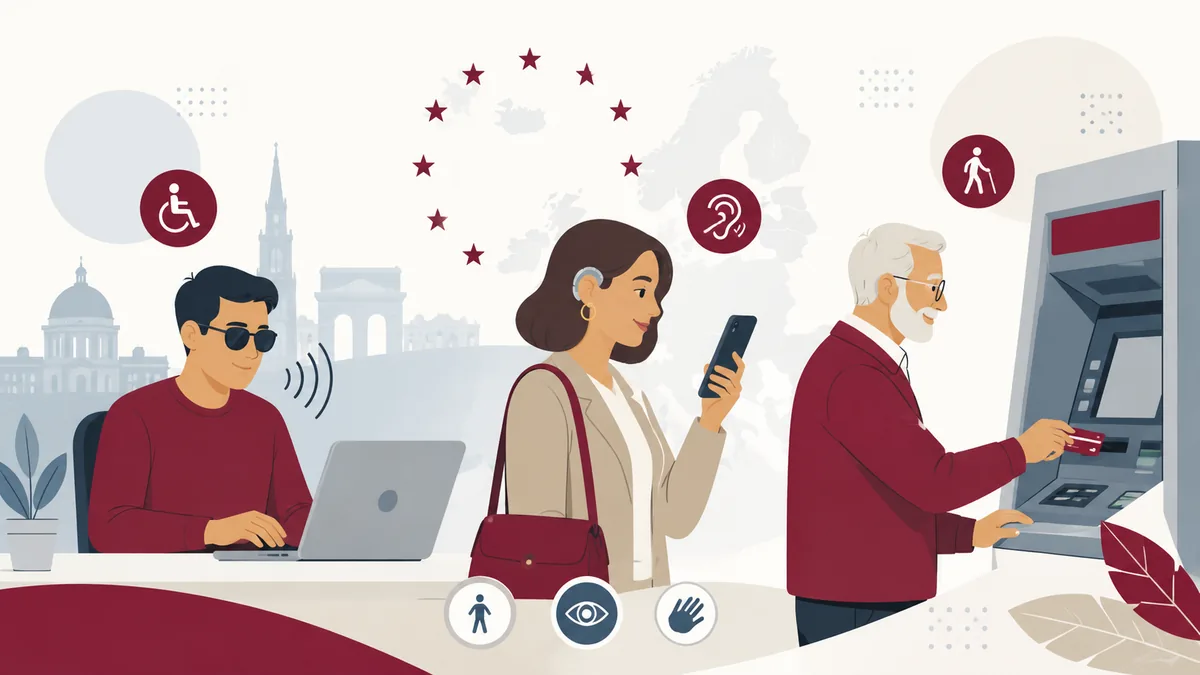
Helps senior citizens as well
Accessibility requirements are good news for the whole community, as, along with the health problems affecting a large part of society, we are also facing the challenges of an ageing population. Consequently, vision and hearing impairments or movement disorders do not only affect persons with disabilities. We may all come to a point when we need some help. The proportion of senior citizens is growing rather than shrinking.
The Accessibility Act is also good news in another context, as the undertaking of joint responsibility is an indication of a society’s maturity. Therefore, we should all think about the ways that the company we represent, or ourselves as individuals, can help others.
What we can already do now is make the lives of our elderly relatives easier by using both special tools and technological solutions. Their implementation will soon be mandatory for information providers. But it is also important to understand what the consumers can request and what they will be able to receive.
Voice control
Voice synthesis is one of the most valuable technology tools to ensure accessibility. The integration of this technology means that it will be possible to listen to information from any web application, webpage or online event. This technology is compatible with voice-controlled devices or website readers. The voice synthesis technology may help people with movement disorders, heavy vision impairments (both low vision and complete loss of vision) and people suffering from dyslexia. For all those people, the play-back of any content in a voice and the possibility to receive information in various modalities (text, image or speech depending on the specific individual’s ability to perceive information) is important.
Another large group of people that will benefit from accessibility tools and technologies is people with hearing impairments; people that are either partly or fully deaf. Speech recognition and automated subtitling will be of great help to them. At the same time, people with learning difficulties will have access to technological solutions, transforming the content into easy language.
How businesses can meet European Accessibility Act requirements
In the case of the Accessibility Act, we can draw similarities to the implementation of another piece of European legislation, the General Data Protection Regulation (GDPR). The only difference is that, in the case of GDPR, data privacy had to be ensured, which was a relatively simple thing to do. That is, websites only needed to store cookies.
The most significant element of the Accessibility Act is that it requires new technological solutions.
It is important for the developers of information resources to know that all these tools have already been developed and are available on the market. Therefore, small and medium-sized enterprises, most likely lacking the budget for developing tailored tools, will be able to comply with the Act’s requirements by making just a small investment. For example, to make a company’s website multilingual, only a plug-in is required. It is also possible to add a synthesiser to play back content in the language selected by the user. These are all already live technical solutions. Now all we need is an initiative on additional financial support for the implementation of technology. This is something we expect from the newly-elected European Parliament.